

Posted 09/01/2014
Thyroid cancer rise in Fukushima
Published time: August 21, 2013 11:46

Japanese Professor Toshihide Tsuda of Okayama University sat down with leaders from the Japanese Ministry of the Environment, to talk about citywide evacuation near the Fukushima nuclear breakdown site began. Deeply concerned about rising thyroid cancer rates in Japanese children, these leaders believe that it’s time to evacuate the city of Koriyama
Six minors in Fukushima Prefecture who were 18 or younger at the time of the March 2011 nuclear disaster have been diagnosed with thyroid cancer since June. Ten other children are believed to have developed the same form of cancer in that time period.
Follow RT’s LIVE UPDATES on the Fukushima leak emergency
The latest figures released by regional authorities brings the total number of children who have been diagnosed with or suspected of having cancer to 44, up from 28 as of June, The Asahi Shimbun national daily reports. Of the 44, 18 have been diagnosed with thyroid cancer, and 25 others are showing symptoms. Another child suspected of having cancer was later diagnosed with a benign tumor.
The prefectural government is giving medical checkups to all 360,000 children aged 18 or younger at the time of the accident at the Fukushima Daiichi plant in March 2011, with the thyroid test results of approximately 193,000 children having been released so far. The check-ups will continue throughout the duration of their lives.
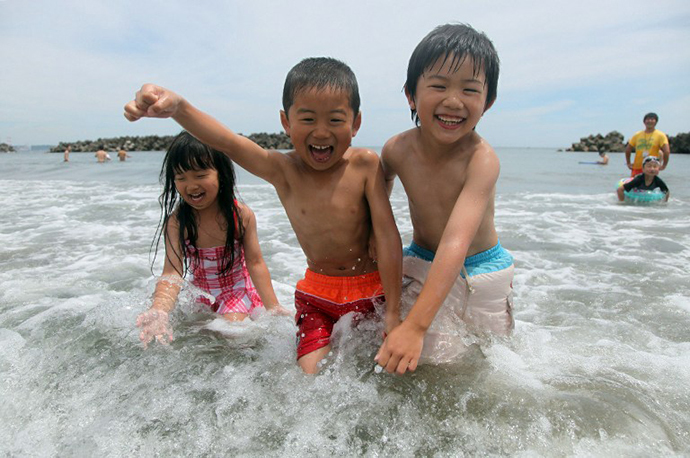
Children swim in the sea at the Nakoso beach in Iwaki city in Fukushima prefecture, 65km south of the crippled TEPCO nuclear power plant, on July 16, 2012 as the beach opened for the season, the first time since the massive earthquake and nuclear accident on March 11, 2011. (AFP Photo)
While radioactive substances released during the accident can accumulate in children’s thyroid glands – increasing the risk of developing cancer – the government says the recent cases are unlikely to be connected with the Fukushima No. 1 nuclear power plant disaster as it generally takes several years after radiation exposure for thyroid cancer to develop.
In the case of the 1986 Chernobyl disaster for example, instances of thyroid cancer cases began soaring four to five years after the event.
“It is likely (the 44 children) developed tumors or lumps before the nuclear accident,” the Japanese daily cites a Fukushima prefectural government official as saying.
The incidence rate of thyroid cancer in Japanese children is said to be one in hundreds of thousands. In Japan, 46 people under 20 were diagnosed with thyroid cancer in 2006, Japan Broadcasting Corporation reports.
However, Christopher Busby from the European Committee on Radiation Risks (ECRR) wrote for RT that “the 2005 Japanese national incidence rate for thyroid cancer in the age bracket 0-18 is given in a recent peer reviewed report as 0.0 per 100,000.”
Busby argues that based on the ECRR’s scientific model, there could be “some 200,000 extra cancers in roughly 10 million of the population in the 200km radius of the site in the next 10 years, and 400,000 over 50 years.”
He further notes that the risk model currently employed by the Japanese government predicts “no detectable cancers will be seen as a result of the ‘very low doses’ received by the population.
He has said their model, the International Commission of Radiological Protection, has produced results which can only be characterized as “nonsense.”
Local residents have been highly critical of the prefectural government’s alleged downplaying of the risk of radiation exposure, the accuracy of its thyroid testing and the means by which information is disclosed.

The government has signaled it will look into the way the tests are being conducted to see if there are any issues.
Meanwhile, some 10,000 people who worked at the Fukushima No. 1 nuclear plant are eligible for workers’ compensation if they develop leukemia.
The government has established standards for workers’ compensation for other forms of cancer, such as malignant lymphoma, multiple myeloma, stomach cancer, esophageal cancer and colon cancer.
Thus far, only four people employed at the plant have applied for compensation for cancer, and their requests are currently under review.
Authorities has been accused of not taking the safety and well-being of workers seriously, with the country’s Health Ministry admitting earlier this month it had no system in place to inform all employees of the standards for worker’s compensation.
Around 90 percent of those who were exposed to hazardous levels of radiation do not meet the criteria for free cancer screenings provided by the ministry and TEPCO – the Fukushima Daiichi power plant owner.
Source:
http://rt.com/news/fukushima-children-thyroid-cancer-783/

 Coercion Code - "Dark Times are upon us"