

Band-Aid… or computer?
A new technology places computer circuitry into a flexible skin patch the size and thickness of a postage stamp
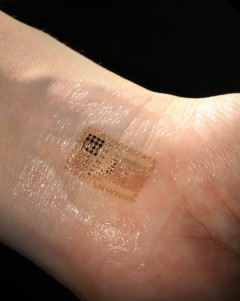
Putting on the epidermal electronic system is as easy as applying a temporary tattoo: Just place one on your skin, rub the sheet with water, and you’re done. Photo: John A. Rogers
Imagine a computer thinner than a piece of tape. That might seem far-fetched, but engineers from the University of Illinois have created a form of electronics that’s so thin and flexible it can be worn like a Band-Aid. Once it hits the marketplace — and it’s not clear yet when that might be — this innovation could be used for everything from music to medicine. “It’s a technology that blurs the distinction between electronics and biology,” says developer John Rogers, as quoted by BBC News. Here, a brief guide:
How does this new device work?
These “epidermal electronics” use a simple network of silicon-based computer circuitry that’s manufactured in a micro-thin membrane. The circuits are then integrated onto elastic, transparent sheets the size and thickness of a postage stamp; these attach to the skin without the need for adhesive. Putting them on is as easy as applying a temporary tattoo: Just place one on your skin, rub the sheet with water, and you’re done.
What uses could this have?
The range of applications is virtually unlimited, especially for health care. Placed on the forearm or chest, they could measure heart rate and other vital statistics. Placed on the neck, they are sensitive enough to pick up throat muscle contractions, so they could help people with speech problems. They could also be used in neonatal care to monitor the health of premature or sick babies. They could even form the basis of a “smart” Band-Aid that would speed wound healing by electrical stimulation.
What about for entertainment?
It’s possible that these circuits could be used to accommodate music players, wi-fi components, or even cell phones that you wear on your skin. The opportunities for gaming, too, are countless, especially since electronic patches can be programmed to respond to subtle body movements or voice commands.
Through a combination of careful theoretical modeling and precise micro-manufacturing, a team of engineers and scientists has developed a new type of ultra-thin, self-adhesive electronics device that can effectively measure data about the human heart, brain waves and muscle activity – all without the use of bulky equipment, conductive fluids, or glues.
The researchers have created a new class of micro-electronics with a technology that they call an epidermal electronic system (EES). They have incorporated miniature sensors, light-emitting diodes, tiny transmitters and receivers, and networks of carefully crafted wire filaments into their initial designs.
The technology is presented-along with initial measurements that researchers captured using the EES-in a paper by lead author Dae-Hyeong Kim of the University of Illinois and colleagues in the August 12, 2011, issue of Science.
The EES device was developed by collaborators from the University of Illinois at Urbana-Champaign, Northwestern University, Tufts University, the Institute of High Performance Computing in Singapore, and Dalian University of Technology in China.
“Our goal was to develop an electronic technology that could integrate with the skin in a way that is mechanically and physiologically invisible to the user,” says corresponding author John Rogers, a professor in materials science and engineering department at the University of Illinois at Urbana-Champaign. “We found a solution that involves devices we designed to achieve physical properties that match to the epidermis itself. It’s a technology that blurs the distinction between electronics and biology.”
While existing technologies accurately measure heart rate, brain waves and muscle activity, EES devices offer the opportunity to seamlessly apply sensors that have almost no weight, no external wires and require negligible power.
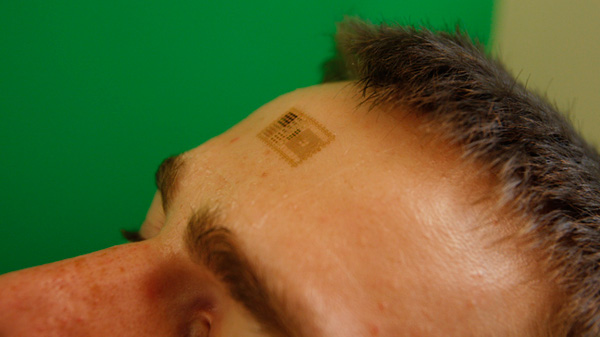
Because of the small power requirements, the devices can draw power from stray (or transmitted) electromagnetic radiation through the process of induction and can harvest a portion of their energy requirements from miniature solar collectors.
The EES designs yield flat devices that are less than 50-microns thick-thinner than the diameter of a human hair-which are integrated onto the polyester backing familiar from stick-on tattoos.
The devices are so thin that close-contact forces called van der Waals interactions dominate the adhesion at the molecular level, so the electronic tattoos adhere to the skin without any glues and stay in place for hours. The recent study demonstrated device lifetimes of up to 24 hours under ideal conditions.
Watch CTV here
http://www.ctv.ca/CTVNews/Health/20110811/electronic-skin-patch-tattoo-110811/
“The mechanics behind the design for our serpentine-shaped electronics makes the device as soft as the human skin,” says Northwestern University engineer Yonggang Huang, also a lead researcher on the project. “The design enables brittle, inorganic semiconductors to achieve extremely vast stretchability and flexibility. Plus, the serpentine design is very useful for self adhesion to any surface without using glues.”
Sources: BBC, Discovery, International Business Times, Science

 Coercion Code - "Dark Times are upon us"