

Posted 5th Feb 2014
First Published 5 Nov 2013
Church, Media, Culture
Steven Furtick’s Church, if you haven’t realised has marvelous manipulated numbers, now is as good a time as any to look back on his 2011 spontaneous baptism event where he carefully manipulated his congregation to herd them through his baptism bath.
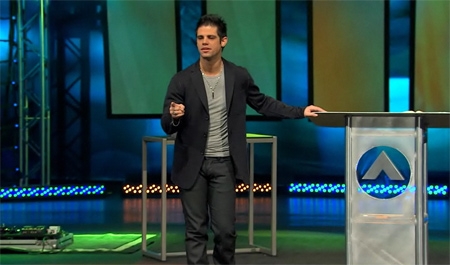
Furtick tells his audience (at 50:20 in this Elevation video),
For a bit of background, Elevation had experienced a couple of lean years for baptisms, which may be why Furtick needed something big to move the numbers. Here’s how Elevation reported its 2010 salvations and baptisms.

Elevation’s salvations and baptisms for 2010
The real story of the numbers is hidden by the tricky way the data is presented cumulatively, which means that the line will never go down. The numbers claimed in 2010 include all the baptisms and salvations from 2006 through 2009 as well. If you look at the actual numbers for each year, you see something very different.
Elevation Salvation & Baptism Statistics
|
Year
|
Salvations
|
Baptisms
|
Percentage Baptized
|
|---|---|---|---|
| 2008 | 2,437 | 1,243 | 51 |
| 2009 | 3,545 | 193 | 5 |
| 2010 | 3,688 | 289 | 8 |
| 2011 | 7,699 | 2,158 | 28 |
| 2012 | 6,097 | Not reported | ? |
The spike in baptisms in 2008 came from Elevation’s first “spontaneous” event, when they baptized 1,044 over two weeks. Outside of those two weeks, they baptized another 199, which is a similar rate to the two years after it. So, even though this Baptist church was adding thousands of salvations, it was unable to get more than a relative handful to follow up with baptism. Either Furtick wasn’t preaching baptism, or he was preaching it poorly, but if you’re a Baptist preacher, you really ought to do better than have only 5 percent of your conversions be baptized. Baptism by full immersion is the most celebrated sacrament (though they call it an ordinance) of the denomination that helped start Furtick’s church. As will be detailed below, Furtick and Elevation solved this problem by meticulously planning a baptism ambush when they would emotionally manipulate as many of the congregation as possible to be baptized immediately.
Before the criticism, a some words of praise. Furtick rightly tells his congregation that they should not seek to be baptized if they have been baptized before as adults, even if it was in another church and even if they’d prefer a more meaningful experience now. His pal, Perry Noble, doesn’t restrict re-baptisms the same way.
Now, returning to regular programming, the problems with this event:
Modus Manipulation
In the moments before his call to action, Furtick tells his audience (at 50:20 in this Elevation video),
You know God is calling you, and if you feel that in your heart, let me assure you that is the Holy Spirit of God calling you. It is not emotional manipulation. It’s the presence of God drawing you and calling you. So in just a moment, I’m going to count to three. When I say “three,” at every campus I want you to move into the aisles and go to the exit where the ushers are stationed at your campus.
No manipulation, all God. Let’s check that out.
As part of the promotional package for Sun Stand Still, Elevation offered what it calls a Spontaneous Baptism How-To Guide (Word doc), which is long on manipulation, and short on the Holy Spirit.
On the Sun Stand Still website, it describes the event in miraculous terms:
Sun Stand Still is about believing God for the impossible. At Elevation Church in the summer of 2011, we saw God move in one of the most amazing ways in the history of our church…
We baptized 2,158 people over 2 weekends. It was unbelievable. It required audacious faith in a God who provides.
The preface to the guide also frames the event as a Sun Stand Still miracle.
As a church we pray Sun Stand Still prayers all the time. We are constantly asking God to do something that seems impossible and then believing that he is going to pull through.
Most recently we prayed and asked God to lead thousands of people to take a public stand in their faith in Christ through baptism. God blew our minds and in two weekends we saw 2158 respond and be baptized.
Except that it didn’t blow their minds at all, and the results underperformed what they expected would be possible. We know this because they explain how they ran the numbers from the 2008 event which showed that 16 percent of attenders responded to the invitation to be baptized. They say they expected the same number the second time, and even used the 2008 numbers to estimate the proportion of females to males (60/40), from which they calculated exactly what size clothing they needed to have on hand for people entering the pool. From the guide:
You will want to calculate the number of each item to be purchased based on your projection of how many people will be baptized, the number of men vs. women, and the breakdown of sizes.
The 2011 event, even with the knowledge gained from the first run, only yielded a 13 percent response, down almost 20 percent from the first time. Elevation almost certainly over-prepared and had hundreds of clothing items they never needed to use. They would have been prepared to baptize at least 1,600 in the first week, but baptized only 1,428. Now, preparation is not necessarily emotional manipulation, though it does suggest that they were relying on the power of raw numbers as much as they were on the feeling in the heart that Furtick assured them was from God. How this blew their minds, I really don’t know. Since 2008, Elevation reported that they saw 14,932 new conversions, of which only 2,640 were baptized, either spontaneously or deliberately. That’s a three-year salvation-to-baptism conversion rate of 18 percent.
Rather than advertising this as a model for other churches to follow, this is a model that should embarrass them and prompt serious change. Perhaps the vast majority of those 15,000 reported salvations, weren’t. What happened to the 12,000 people who “made a decision” at Elevation yet didn’t get baptized? For a Baptist pastor who cared for his flock, that ought to be mind blowing.
Blind Guides
For the few that Elevation did baptize, their how-to guide documents exactly how they used emotional manipulation to get people from their seats to the pool. Volunteers were placed throughout the campuses to make sure the baptism candidates maintained the emotional fervor that Furtick had created in the service.
Here are some of the instructions from the guide:
[At the doors] Smile and clap showing people you are excited they came forward.
[For the 30-60 volunteers lining the hallway] Create an atmosphere of Celebration for those being baptized as they walk toward the changing rooms…this needs to be HUGE and over the top celebration!!!!!!!!!!!!!!!!!
[For the teams escorting people to the pools] Start in the hallway smiling, clapping and creating an atmosphere of excitement and help direct people to the changing rooms.
Have them take out their phones and tweet #follow that they are being baptized today!! …We created a hash tag on Twitter and tweeted individual stories. We had a crawl on our iMag screens of live twitter feed to build excitement during the Worship Experiences.
Perhaps you could classify this as encouragement for a decision already made, not manipulation. You could, though if this were a decision made with confidence and determination, there would be no need to constantly reinforce that decision. Why I classify these as manipulative comes from the very first action, performed just seconds after Furtick’s assurance that he wasn’t manipulating them. As you saw above, Furtick prepares them for action, then counts down from three (that should be the clue, right there). Look at what happens when he gets to zero:
15 people will sit in the worship experience and be the first ones to move when Pastor gives the call.
- Sit in the auditorium and begin moving forward when Pastor Steven says go.
- Move intentionally through the highest visibility areas and the longest walk.
Elevation has seeded its four auditoriums with 60 shills who pretend to be responding to the call. Their high-visibility movement is designed to manipulate others to follow. If Furtick was confident in his message and in the efficacy of the Holy Spirit’s call, he shouldn’t need fake converts.
This is even more interesting for Furtick’s restriction on re-baptisms. We know these 60 are official volunteers, so it’s almost certain all had already been baptized. That means that if they melted away out of the lines later on, their response in the auditorium was a lie. For good doctrinal reasons that even Steven Furtick understands, they never ought to have responded in the first place. Not only are they lying, they are pretending to sinfully partake in the most important sacrament of their church. That’s serious stuff for a pastor and church to be encouraging.
(It’s possible these were people who needed to be baptized, though there’s nothing in the document that indicates how the church would find the 360 people that would have been needed to cover its four campuses meeting a total of 24 times over the two weeks. He would need to have recruited twice as many people as Elevation baptizes in a whole year, and have each one agree to participate in the trick and keep quiet about it. It didn’t happen.)
Perhaps Furtick realized that his own preaching wasn’t enough. Look at Elevation’s numbers again. Without a mass event, Furtick couldn’t convince more than about 200 in any year to be baptized, so he needed to add manipulation to his message. In his book, Influence, Robert Cialdini describes a persuasive method called Social Proof, the idea that “the greater the number of people who find any idea correct, the more the idea will be correct.” The reason the 60 volunteers were asked to stand was to assure the people sitting behind them that instantly responding to the Furtick Countdown was right. Cialdini gives a few examples of this, but in one he describes the persuasive genius of Jim Jones.
Although he was without question a man of rare dynamism, the power he wielded strikes me as coming less from his remarkable personal style than from his understanding of fundamental psychological principles. His real genius as a leader was his realization of the limitations of individual leadership. No leader can hope to persuade, regularly and single-handedly, all the members of the group. A forceful leader can reasonably expect, however, to persuade some sizable proportion of group members. Then the raw information that a substantial number of group members has been convinced can, by itself, convince the rest. Thus the most influential leaders are those who know how to arrange group conditions to allow the principle of social proof to work maximally in their favor. (p. 156)

Furtick isn’t Jones, but their persuasive techniques are identical.
Source:
Read moe at http://www.pajamapages.com/how-steven-furtick-engineered-a-spontaneous-miracle/

 Coercion Code - "Dark Times are upon us"