


Lance Goodall 16 April 2019
Paris races to save Notre-Dame Cathedral as fire destroys steeple
French firefighters were racing Monday to save Notre-Dame Cathedral in Paris after a colossal fire caused the spire of the historic edifice to crash to the ground and wiped out centuries of heritage. The French government reported that they ‘may not’ be able to save the historic church.
The fire already destroyed the roof of the 850 year old UNESCO world heritage landmark, whose spectacular gothic spire collapsed before the eyes of horrified onlookers on a previously pristine early spring evening.
Paris’ Notre Dame Cathedral has been saved from “total destruction,” according to a French fire official, after a massive fire ripped through the structure on Monday and caused the roof and main spire to collapse.
The official estimated it could take up to seven hours from the initial outbreak to contain the fire, French24 television reported, but the official said the two iconic rectangular towers have now been saved. That news come as a relief after one of the towers caught fire earlier in the evening. Earlier, a French Interior Ministry official had said that firefighters might not be able to save the cathedral.
Notre Dame Cathedral was undergoing $6.8 million in renovations on the church’s spire and its 250 tons of lead when a massive fire engulfed the Paris landmark on Monday.
The cathedral, which is visited by 13 million people per year, was undergoing renovations after cracks began to appear in the stone, sparking fears the structure could become unstable.
“The worst has been avoided, but the battle isn’t fully won yet,” French President Emmanuel Macron said in a statement outside of the cathedral. He also expressed his sympathies to Catholics around the world, the people of Paris and the people of France.
The fire broke out just days before Easter.
The fire, which came as Catholics prepare to celebrate Easter, sent orange flames and clouds of grey smoke billowing into the sky as stunned Parisians and tourists watched on in horror.
Some were in tears, others offered prayers from the banks of the river Seine as the inferno devoured the cathedral.

As darkness fell, some 400 firefighters battled against the odds to control the fire and save at least its iconic front towers which were still standing.
“This is really sad —- the saddest thing I’ve ever stood and watched in my life,” said British tourist Sam Ogden, a 50-year-old onlooker, who had come to visit the cathedral with her family.
Gasps and cries of “Oh my god” erupted around an hour after the fire first broke out when the top portion of the church’s spire came crashing down.
‘France is Notre Dame’
The cause of the blaze was not immediately confirmed. The cathedral had been undergoing intense restoration work which the fire service said could be linked to the blaze.
Last week, dramatic footage had shown workers removing 16 copper statues from the spire which was undergoing a revamp financed by the state and private donors.
Historians expressed incredulity at the collapse of a building that has been a symbol of France for almost a millenium and withstood war and revolution.
On Fox News host Shepard Smith abruptly cut off a French government official describing the burning of the Notre Dame cathedral after he suggested that the blaze may not have been accidental.
“I would tell you something, even if nobody died, it’s like a 9/11, the French 9/11,” French official Philippe Karsenty said of the historic cathedral’s burning on Monday.
“And it’s a big shock. I mean, this church was there for more than 850 years, even the Nazis didn’t dare to destroy it.”
Philippe Karsenty then explained the routine Islamic attacks against churches throughout France, and alluded that the media is spreading the “politically correct” narrative that the cathedral’s burning is accidental before being suddenly cut off by Smith.
“And you need to know that for the past year we’ve had churches desecrated each and every week in France. All over France. Of course you will hear the stories about the political correctness which will tell you that it’s probably an accident — ”
“Sir? Sir. Sir. We’re not going to speculate here of the cause of something which we don’t know,” Smith said.
“I’m just telling you something, we need to be ready — ” Karsenty began.
“No sir. We’re not doing that here. Not now, not on my watch,” Smith snapped.
Coincidentally, Fox host Neil Cavuto reportedly also abruptly cut off the Catholic League president Bill Donahue for insinuating the fire was intentionally caused.

“If Paris is the Eiffel Tower then France is Notre Dame. It’s the entire culture, entire history of France incarnated in this monument,” Bernard Lecompte, a writer and specialist in religious history told BFM TV.
Deputy Paris mayor Emmanuel Gregoire told the channel that workers were scrambling “to save all the artworks that can be saved.”
A spokesman for the cathedral told AFP that the wooden structure supporting the roof was being gutted by the blaze.
“Everything is burning,” the spokesman, Andre Finot, told AFP.
Senior Paris fire service official General Jean-Claude Gallet told reporters at the scene it was not certain if the spread of the fire to the northern bell tower could be stopped.
Deputy Interior Minister Laurent Nunez, also speaking at the scene, added that saving the Gothic monument “is not certain.”
France: Catholic Churches Vandalized, Set on fire, Smeared with Excrement
There has been hostility to the Catholic Church in France for centuries, but this kind of thing did not happen.
Could it have anything to do with the introduction into France of a large population of people who believe that Christianity is a false religion and that they are commanded to fight unbelievers so that Allah may punish them by the hands of the believers (cf. Qur’an 9:14-15)? Possibly not. But possibly.
“Catholic churches in France vandalized, set on fire & smeared with excrement (PHOTOS, VIDEO),” RT, March 22, 2019:
Catholic churches in France are being targeted with arson attacks, vandalism, desecration of holy statues, and the destruction of the Eucharist. The attacks have been happening since the start of the year.
The Church of St. Sulpice in Paris, where the Da Vinci Code movie was filmed, was set on fire just after midday mass on Sunday, Le Parisien reports. Firefighters and police said the blaze was an arson attack.
In February, a 19th century statue of the Virgin Mary was smashed at the St. Nicholas Catholic Church in Houilles. The statue was “completely pulverized,” Father Francois-Laurent Heart said. “It is irreparable.” The church reported three incidents in 10 days, with a cross also thrown on the floor by vandals.
At Saint-Alain Cathedral in Lavaur, statues and crosses were smashed and an altar cloth was burned in February. A statue of Christ on a cross was also interfered with, as vandals twisted one of the arms to make it appear that Jesus was dabbing, La Depeche reports. Two teenagers were later arrested over the damage.
Meanwhile, the Notre-Dame des Enfants church in Nimes was looted and vandals used human excrement to draw a cross on the wall in February. Consecrated hosts of unleavened bread, which Catholics believe is the body of Jesus Christ, were found scattered outside with rubbish.
Also in February, eucharistic hosts were stolen and scattered around Notre-Dame church in Dijon, with Father Emmanuel Pic denouncing the attack as on the “heart of the Catholic faith.”…
————————–
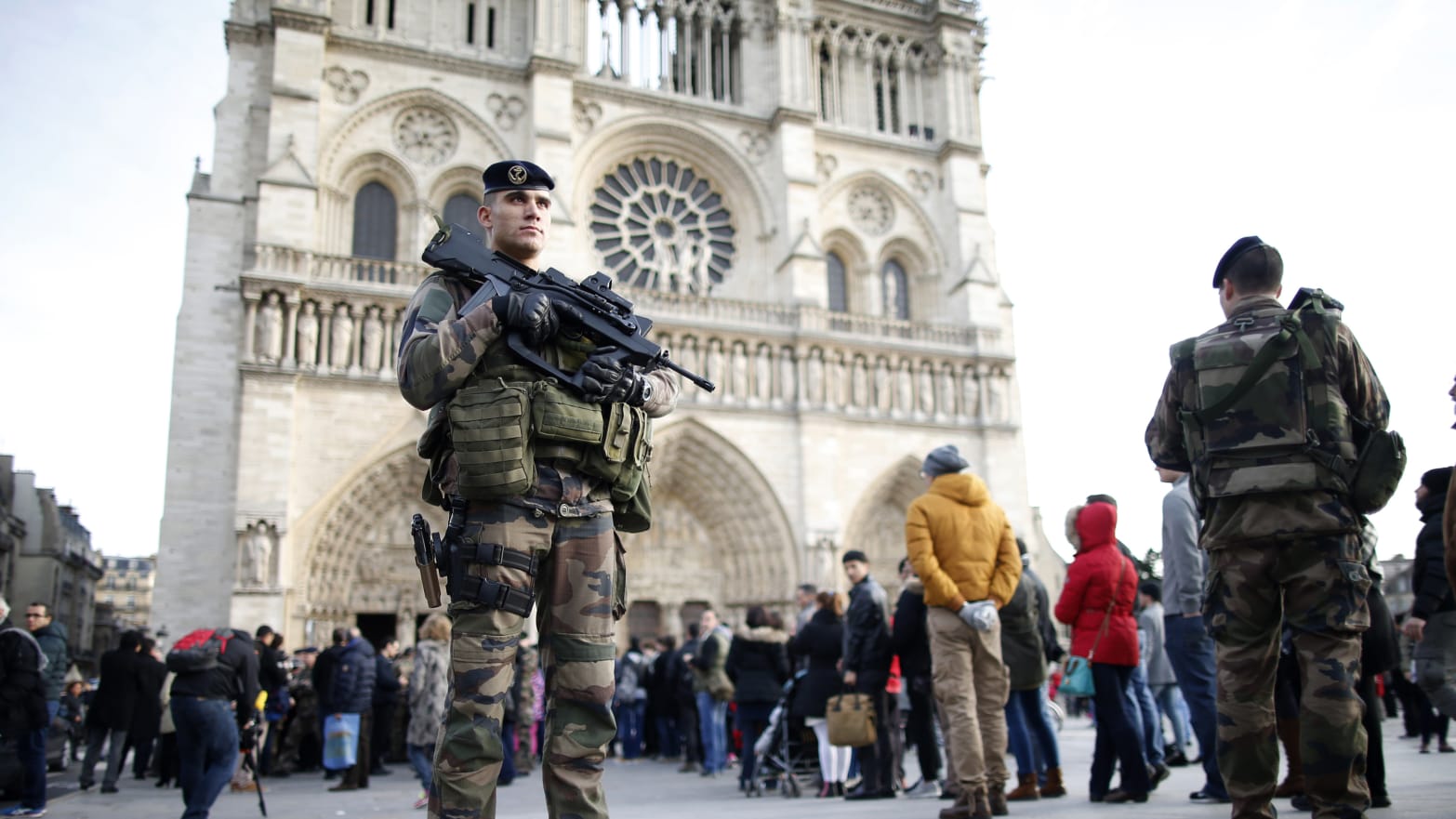
This article is more than 2 years old
ISIS behind failed Notre Dame attack in 2016
Police say another operation was planned by group, one of whom had been engaged to two men who carried out deadly attacks
- 2019 Notre Dame fire updates – police say fire began accidentally and may be linked to building work at cathedral
A cell of radicalised French women guided by Islamic State commanders in Syria was behind a failed terrorist attack near Paris’s Notre Dame Cathedral last weekend and planned another violent attack this week before they were intercepted by police, the Paris prosecutor has said.
The women, aged 19, 23 and 39, were arrested in Boussy-Saint-Antoine, a small town 19 miles (30km) south-east of Paris, on Thursday night after they were linked to the discovery of a car packed with gas cylinders parked near the cathedral last weekend. Officials said the women had been planning an imminent violent attack on the busy Gare de Lyon station in Paris and were stopped after a police and intelligence operation described as a “race against time”.
The Paris prosecutor, François Molins, said one of the women arrested, who he referred to as Sarah H, aged 23, had been engaged at different times to two French extremists who themselves had carried out deadly attacks this year.
She had been engaged to Larossi Abballa, who in June murdered a police commander and his police officer partner at their home in Magnanville outside Paris in the presence of their three-year-old son. He filmed the aftermath on Facebook Live before dying in a police raid. She was also betrothed to Adel Kermiche, who slit the throat of an elderly French priest during morning mass in Normandy in July. Her current fiancé was arrested on Thursday, Molins said.
The prosecutor said the cell of women terrorists showed that Islamic State“intends to make women into fighters”. He said that if women had previously been “confined to family and domestic tasks” by the militant group, that vision was now strongly out of date. “Their aim was to commit an attack,” he said of the women.
The group’s first attempted attack involved parking a Peugeot 607 car packed with gas cylinders near the cathedral in the heart of Paris and trying to blow it up. The car was also found to have contained diesel canisters and a barely-smoked cigarette had been thrown into the car near a canister with traces of hydrocarbons. Molins said the perpetrators had clearly tried to blow the car up and if they had succeeded it would have led to the explosion of the whole vehicle.
The car had no plates and was left with indicators flashing in a narrow alley. From the insurance sticker on the car, police traced it back to a father of five daughters originally from the Seine-Saint-Denis area north of Paris.
One of the daughters, aged 19, who was named by news agencies as Ines Madani, was known to intelligence agencies and had been on a radicalisation watchlist for her wish to leave to join jihadis in Syria. At the time the car was found, she had been missing from home for several days.
Police on Thursday traced Madani and two other women to a flat in Boussy-Saint-Antoine in the Essonne area south of Paris. They arrested the three women when they left the flat. During the arrest, one of the women stabbed a police officer with a large kitchen knife, and Madani jumped on another officer attempting to stab him. The police opened fire and Madani was injured. When she was arrested, Madani had the keys to the Peugeot 607 in her handbag and a note pledging her allegiance to Isis and a reproduction of an Isis text vowing “we will attack you on your territory to attack your spirits and terrorise you”. Isis propaganda was found on her computer at her home.
A 15-year-old girl, who is the daughter of one of the three women arrested, Amel S, was separately detained on Friday morning in Clichy-sous-Bois, north of Paris. The prosecutor said the teenager could have been implicated in the planned terrorist attack.
The French interior minister, Bernard Cazeneuve, had said of the three women detained on Thursday that they were “radicalised and fanaticised” and believed to have been preparing “new and imminent violent action”. He said there had been a “race against time” to stop them, involving a vast police and intelligence operation.
“France is confronted with a terrorist threat of unprecedented scale,” he added. The changing threat took different forms and was very hard to detect, he added, calling for the “vigilance of all citizens”.
The French president, François Hollande, said: “There’s a group that has been annihilated, but there are others. Information we were able to get from our intelligence services allowed us to act before it was too late.’’
Speaking on Friday morning, an interior ministry official told Reuters: “An alert has been issued to all stations, but they had planned to attack the Gare de Lyon on Thursday.”
The train station, one of the busiest in Paris, is in the south-east of the capital.
The discovery of the Peugeot 607 near Notre Dame carrying seven gas cylinders, six of them full, led to a terrorism investigation and revived fears about further attacks in a country where Islamic militants have killed more than 230 people since January 2015.
Several people have been arrested and questioned in the case of the car of gas cylinders. A 27-year-old man and a 26-year-old woman were detained on Wednesday south of Paris and a second couple, a 34-year-old man and a 29-year-old woman, were detained on Tuesday.
Earlier this week, Florence Berthout, the mayor of Paris’s fifth arrondissement, said the discovery of the car highlighted the need to increase security in the French capital. “Police and army staffing must be stepped up,” she told news channel BFMTV.
The vehicle was left in a zone where parking is strictly prohibited and had remained there for about two hours before it came to the attention of police after being reported by a waiter at a nearby restaurant, she said.
Thousands of extra police and soldiers have been deployed to protect sensitive sites across France. A state of emergency declared after the coordinated attacks on Paris last November remains in place and gives police extra search and arrest powers, but there has been a continuing political debate about security levels since 85 people were killed when a man driving a lorry ploughed into crowds celebrating Bastille Day on 14 July in Nice.
European Churches: Vandalized, Defecated On, and Torched “Every Day”
Translations of this item:
- In Germany, four separate churches were vandalized and/or torched in March alone. “In this country,” PI-News, a German news site, explained, “there is a creeping war against everything that symbolizes Christianity: attacks on mountain-summit crosses, on sacred statues by the wayside, on churches… and recently also on cemeteries.”
- In virtually every instance of church attacks, authorities and media obfuscate the identity of the vandals. In those rare instances when the Muslim (or “migrant”) identity of the destroyers is leaked, the desecraters are then presented as suffering from mental health issues.
- “Hardly anyone writes and speaks about the increasing attacks on Christian symbols. There is an eloquent silence in both France and Germany about the scandal of the desecrations and the origin of the perpetrators…. Not a word, not even the slightest hint that could in anyway lead to the suspicion of migrants… It is not the perpetrators who are in danger of being ostracized, but those who dare to associate the desecration of Christian symbols with immigrant imports. They are accused of hatred, hate speech and racism.” — PI News, March 24, 2019
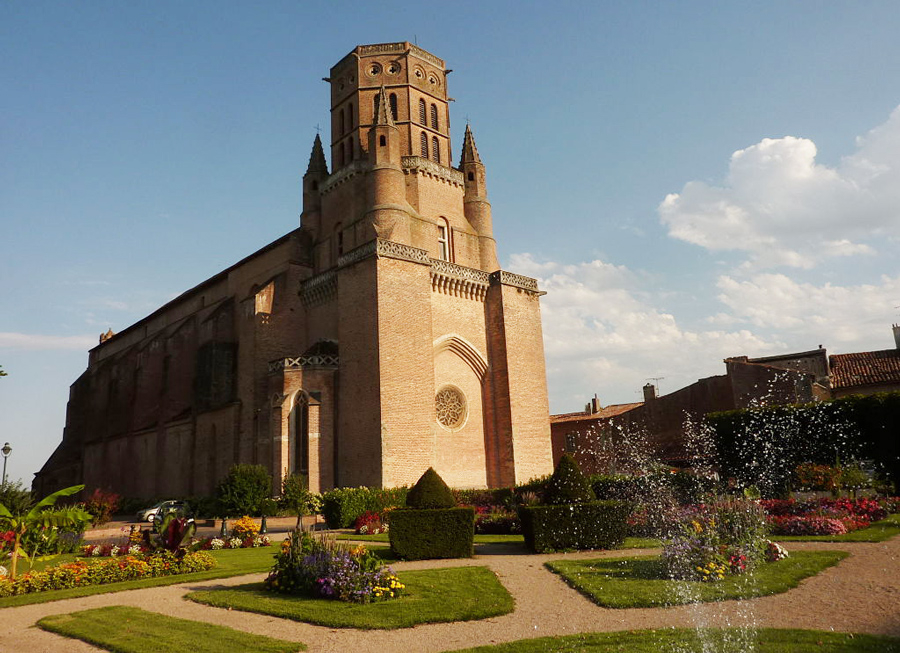 In February, vandals desecrated and smashed crosses and statues at Saint-Alain Cathedral in Lavaur, France, and mangled the arms of a statue of a crucified Christ in a mocking manner. In addition, an altar cloth was burned. (Image source: Eutrope/Wikimedia Commons) In February, vandals desecrated and smashed crosses and statues at Saint-Alain Cathedral in Lavaur, France, and mangled the arms of a statue of a crucified Christ in a mocking manner. In addition, an altar cloth was burned. (Image source: Eutrope/Wikimedia Commons) |
Countless churches throughout Western Europe are being vandalized, defecated on, and torched.
In France, two churches are desecrated every day on average. According to PI-News, a German news site, 1,063 attacks on Christian churches or symbols (crucifixes, icons, statues) were registered in France in 2018. This represents a 17% increase compared to the previous year (2017), when 878 attacks were registered— meaning that such attacks are only going from bad to worse.
Among some of the recent desecrations in France, the following took place in just February and March:
- Vandals plundered Notre-Dame des Enfants Church in Nîmes and used human excrement to draw a cross there; consecrated bread was found thrown outside among garbage.
- The Saint-Nicolas Church in Houilles was vandalized on three separate occasions in February; a 19th century statue of the Virgin Mary, regarded as “irreparable,” was “completely pulverized,” said a clergyman; and a hanging cross was thrown to the floor.
- Vandals desecrated and smashed crosses and statues at Saint-Alain Cathedral in Lavaur, and mangled the arms of a statue of a crucified Christ in a mocking manner. In addition, an altar cloth was burned.
- Arsonists torched the Church of St. Sulpice in Paris soon after midday mass on Sunday, March 17.
Similar reports are coming out of Germany. Four separate churches were vandalized and/or torched in March alone. “In this country,” PI-News explained, “there is a creeping war against everything that symbolizes Christianity: attacks on mountain-summit crosses, on sacred statues by the wayside, on churches… and recently also on cemeteries.”
Who is primarily behind these ongoing and increasing attacks on churches in Europe? The same German report offers a hint: “Crosses are broken, altars smashed, Bibles set on fire, baptismal fonts overturned, and the church doors smeared with Islamic expressions like ‘Allahu Akbar.'”
Another German report from November 11, 2017 noted that in the Alps and Bavaria alone, around 200 churches were attacked and many crosses broken: “Police are currently dealing with church desecrations again and again. The perpetrators are often youthful rioters with a migration background.” Elsewhere they are described as “young Islamists.”
Sometimes, sadly, in European regions with large Muslim populations, there seems to be a concomitant rise in attacks on churches and Christian symbols. Before Christmas 2016, in the North Rhine-Westphalia region of Germany, where more than a million Muslims reside, some 50 public Christian statues (including those of Jesus) were beheaded and crucifixes broken.
In 2016, following the arrival in Germany of another million mostly Muslim migrants, a local newspaper reported that in the town of Dülmen, “‘not a day goes by’ without attacks on religious statues in the town of less than 50,000 people, and the immediate surrounding area.”
In France it also seems that where the number of Muslim migrants increases, so do attacks on churches. A January 2017 study revealed that, “Islamist extremist attacks on Christians” in France rose by 38 percent, going from 273 attacks in 2015 to 376 in 2016; the majority occurred during Christmas season and “many of the attacks took place in churches and other places of worship.”
As a typical example, in 2014, a Muslim man committed “major acts of vandalism” inside a historic Catholic church in Thonon-les-Bains. According to a report (with pictures) he “overturned and broke two altars, the candelabras and lecterns, destroyed statues, tore down a tabernacle, twisted a massive bronze cross, smashed in a sacristy door and even broke some stained-glass windows.” He also “trampled on” the Eucharist.
For similar examples in other European countries, please see here, here, here, here, and here.
In virtually every instance of church attacks, authorities and media obfuscate the identity of the vandals. In those rare instances when the Muslim (or “migrant”) identity of the destroyers is leaked, the perpetrators are then presented as suffering from mental health issues. As the recent PI-News report says:
“Hardly anyone writes and speaks about the increasing attacks on Christian symbols. There is an eloquent silence in both France and Germany about the scandal of the desecrations and the origin of the perpetrators…. Not a word, not even the slightest hint that could in anyway lead to the suspicion of migrants… It is not the perpetrators who are in danger of being ostracized, but those who dare to associate the desecration of Christian symbols with immigrant imports. They are accused of hatred, hate speech and racism.”
Raymond Ibrahim, author of the new book, Sword and Scimitar, Fourteen Centuries of War between Islam and the West, is a Distinguished Senior Fellow at the Gatestone Institute and a Judith Rosen Friedman Fellow at the Middle East Forum.

 Coercion Code - "Dark Times are upon us"