
Muslim Mary and the new hope for conversion – Catholicism and Islam
TheChristians.com
Aug 22, 2013
Devotion to Mary, mother of Jesus, divides Catholic and Protestant Christians. Yet to a surprising degree it brings together Christians with Muslims.
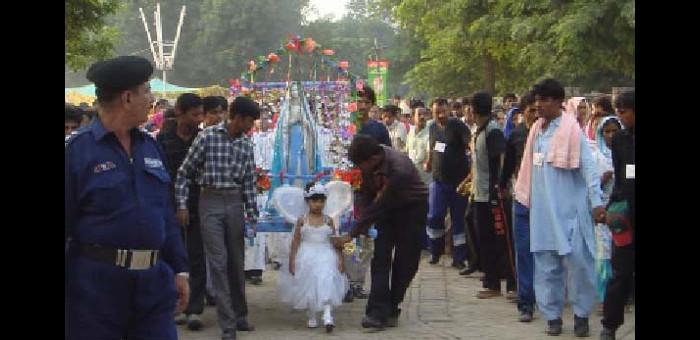
A Marian procession in 2009 in Mariamabad, Pakistan drew 500,000 pilgrims, both Christian and Muslim.
Although a point of controversy between Catholics and Protestants, Mary holds a place in the hearts of the Islamic World.
For example, August 15, the Catholic feast of the Assumption of Mary into heaven, is holy also to Muslims for the same reason, and is therefore a national holiday in Lebanon. Muslim and Christian beliefs about Jesus are contradictory.
To Muslims Jesus is a human prophet who was never crucified, whereas to Christians he is God incarnate and loving savior, crucified for the sins of all and risen from the dead. A rare point of accord Mary, on the other hand, is to Muslims, as she is to most Christians, the greatest woman who ever lived, one who never sinned, conceived herself without sin, a virgin impregnated by God, who was assumed into heaven when her earthly life was over.
The Koran names no woman except Mary, and says more about her than the Bible does, much of it taken from the second-century apocryphal Gospel of James.

Every year hundreds of thousands of Muslims, especially women, visit her many shrines – both Christian and Islamic – scattered from Java to Portugal. Some pray the rosary and other devotions to Mary and Eastern Christian saints. At some sites Muslim infants are quickly and quietly baptised (Islam has no baptism), and demons are exorcized – a job for which Christian monks are much appreciated by ordinary Muslims. A Persian madonna and childTo Islamic puritans like Egypt’s Salafists, there is only one legitimate pilgrimage – the one to Mecca – and any praying to Mary for God’s blessing is idolatrous. They therefore harass, attack and destroy pilgrimage sites where they can; yet the pilgrimages continue.
The documented, widely attested apparitions of Mary at Fatima (1917) and Cairo (1968 and 1971) are described, the former on pages 32-33, the latter on 359-361. Marian apparitions As they beheld Islamic fanaticism re-emerging in the last century, Catholics and Orthodox saw as providential the growing frequency of Mary’s appearances to throughout the Middle East.
As Bishop Fulton Sheen put it in his 1952 book The World’s First Love, nowhere does the Catholic maxim “to Jesus through Mary” better apply than in the Muslim world. She never glorifies herself – it is always to bring people into the love of God. Even the famous 1917 apparition at the obscure Portugese village of Fatima, Sheen wrote, was in large part about Islam.
Why choose obscure little Fatima of all places? Because, reasoned Sheen, it was named for the converted Muslim wife of the Christian prince who drove the Muslims from the region. She was named Fatima after the daughter of Islam’s prophet and founder, Mohammed – who pronounced her the greatest woman in the world after Mary, and like Mary a role model for Muslim womanhood. Because of its name, Muslim mothers come by the planeload from as far away as Iran to Mary’s shrine at Fatima every year. Their religion sternly denies them a personal relationship with Jesus; but they may talk to his mother.
Further reading “Millions of Muslims devoted to Our Lady,” Fr. Samir Khalil Samir, Asianews, July 26, 2013
Bishop Fulton Sheen’s chapter on Mary’s role in the conversion of Islam, 1952.
– See more at: http://thechristians.com/?q=node/556#sthash.5KvEnmVA.dpuf

 Coercion Code - "Dark Times are upon us"
Mary does not lead them into heaven. Only Jesus does that. Many Moslems find Christ and not Mary – as in Indonesia, some crowds of them. I have met those who had even died and met with Christ, came back to life, confessed Him to their families – were driven out. Others have been tortured for their faith. They will come to a meeting preaching healing in the Name of Jesus but never for salvation – except for the few who will find Him as Savior. There will always only be the ‘remnant’ in true Christianity as there have been from Jewry, those who find Christ.